

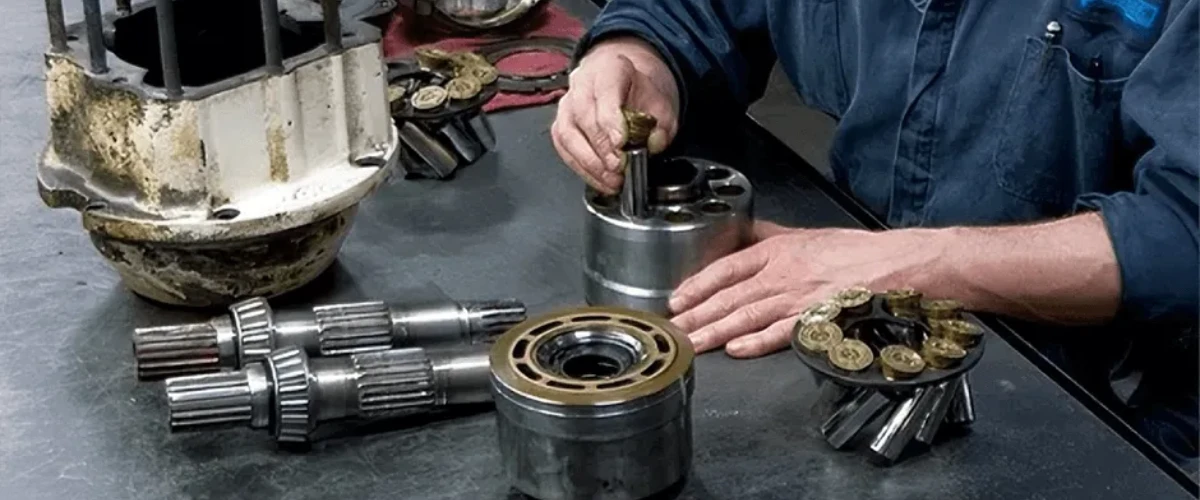
The Complete Guide to Hydraulic Piston Pump Repair
Hydraulic piston pumps are precision-engineered components designed to withstand extreme pressures in demanding environments such as construction sites, manufacturing plants, and mining operations. Their ability to deliver high efficiency and power makes them indispensable, but their complexity means that repair requires specialized knowledge, advanced tools, and meticulous attention to detail. At Sidra Hydraulic Service, we have mastered the art and science of hydraulic piston pump repair, restoring these critical components to optimal performance and reliability through a systematic, quality-driven process.
Understanding Hydraulic Piston Pumps:
Unlike gear or vane pumps, piston pumps use reciprocating pistons to generate flow, making them ideal for high-pressure applications up to 6,000 PSI or more. They come in two main configurations: axial piston pumps, where pistons move parallel to the drive shaft, and bent-axis piston pumps, which offer higher efficiency for demanding applications. Common in excavators, cranes, presses, and heavy industrial machinery, these pumps require precision clearances measured in microns to operate efficiently.
Common Causes of Piston Pump Failure:
1. Fluid Contamination
Contamination is the number one killer of hydraulic piston pumps. Abrasive particles in the fluid act like sandpaper on precision-machined surfaces, wearing down pistons, cylinder barrels, and valve plates. Even microscopic particles can score surfaces, increasing internal leakage and reducing efficiency.
2. Cavitation and Aeration
Cavitation occurs when the pump doesn't receive enough fluid, causing vacuum conditions that form vapor bubbles. These bubbles implode against metal surfaces, eroding material and creating pitting. Aeration, caused by air entering the system, leads to spongy operation, overheating, and accelerated component wear.
3. Overheating
Excessive heat breaks down the fluid's film strength, allowing metal-to-metal contact. It also degrades seals and O-rings, leading to leaks and contamination entry. Chronic overheating often indicates underlying issues such as worn components, incorrect fluid viscosity, or system inefficiencies.
4. Normal Wear and Fatigue
Even in well-maintained systems, components eventually wear out. The constant sliding motion between pistons and barrel, combined with high-pressure forces, gradually increases clearances beyond design specifications, reducing volumetric efficiency.
Our Step-by-Step Piston Pump Repair Process:
Step 1: Comprehensive Initial Assessment
Every repair begins with a thorough evaluation. We inspect the pump externally for damage, check shaft play, and document the failure symptoms reported by the operator. This initial assessment guides our disassembly approach.
Step 2: Complete Disassembly and Cleaning
Our technicians carefully disassemble the pump, noting the condition and orientation of components. We then thoroughly clean all parts using specialized solvents to remove varnish, sludge, and contaminants, revealing the true condition of each component.
Step 3: Precision Inspection and Measurement
Using advanced diagnostic technology, we measure critical components against OEM specifications:
Pistons and Cylinder Barrel: We check for scoring, galling, and measure clearance tolerances.
Valve Plate: We inspect the wear pattern and flatness; excessive wear here causes significant internal leakage.
Swash Plate and Bearings: We examine for brinelling, spalling, and smooth operation.
Housing: We check for cracks, warpage, and damage to mounting surfaces.
Step 4: Component Replacement or Reconditioning
Based on inspection findings, we replace all worn or damaged components with high-quality OEM or equivalent parts. This typically includes new piston slippers, cylinder barrel, valve plate, seals, bearings, and wear plates. Where possible, we recondition reusable components to restore original geometry.
Step 5: Meticulous Reassembly
Reassembly is performed in a clean, controlled environment. We follow exact torque specifications, alignment procedures, and clearance settings. Every seal and O-ring is lubricated during installation to prevent damage and ensure proper sealing.
Step 6: Performance Testing
Before returning the pump to you, we conduct rigorous performance testing to verify:
Flow rate at various pressures
Volumetric efficiency
Case drain leakage
Operating temperature
Noise levels
Pressure compensation and control functions
This testing ensures the rebuilt pump meets or exceeds original performance specifications.
Why Professional Repair Matters:
Attempting to repair hydraulic piston pumps without proper training and equipment often results in recurring failures, secondary damage to other system components, and ultimately higher costs. Our skilled workmanship and strict quality control protocols ensure that every pump we repair delivers long service life and consistent performance.
Comprehensive Support Beyond Repair:
At Sidra Hydraulic Service, we offer more than just pump repair. Our comprehensive service range includes hydraulic motor repair, hydraulic valve repair, and complete system troubleshooting. We stand behind our work with a commitment to timely and cost-effective solutions, supported by 24/7 customer support for emergency situations.
Conclusion:
Hydraulic piston pump repair is a specialized discipline requiring technical expertise, precision equipment, and unwavering attention to quality. With over 15 years of experience, Sidra Hydraulic Service has earned a reputation as a reliable partner for industries relying on hydraulic power. Trust us to restore your piston pumps to peak condition and keep your operations productive.