
Hydraulic Motor Repair – Common Causes of Failure and Solutions
Hydraulic motors are the driving force behind countless industrial and mobile applications, converting hydraulic pressure into rotary mechanical power to operate conveyors, winches, drill heads, mixer drives, and track drives on heavy equipment. When a hydraulic motor fails, production stops, deadlines are missed, and revenue is lost. At Sidra Hydraulic Service, we specialize in comprehensive hydraulic motor repair, helping clients quickly return to full operation with reliable, long-lasting solutions.
Understanding Hydraulic Motors:
Hydraulic motors come in various designs—gear motors, vane motors, and piston motors—each suited for specific applications. Gear motors are simple and durable for moderate-pressure use, while piston motors deliver high torque and efficiency for demanding applications like excavator track drives and industrial rotary systems. Regardless of type, all hydraulic motors share common failure mechanisms that our experts at Sidra Hydraulic Service encounter daily.
Common Causes of Hydraulic Motor Failure:
1. Contamination and Fluid Degradation
Contamination remains the leading cause of hydraulic motor failure. Dirt, debris, water, and wear particles circulating in the hydraulic fluid act as abrasives, gradually eroding internal surfaces. In gear motors, contamination wears down gear teeth and housing walls, increasing internal leakage. In piston motors, contaminants score cylinder barrels, pistons, and valve plates, destroying precision clearances and reducing efficiency.
2. Seal and Bearing Wear
Hydraulic motors rely on seals to contain high-pressure fluid and bearings to support rotating shafts. Over time, seals harden, crack, and leak due to heat, pressure cycles, and chemical breakdown. Worn bearings allow shaft runout, which damages seals and causes metal-to-metal contact between rotating and stationary components. This leads to rapid, catastrophic failure if not addressed promptly.
3. Cavitation Damage
Cavitation occurs when the motor demands more fluid than the supply line can provide, creating vacuum conditions that form vapor bubbles. When these bubbles collapse against metal surfaces, they create microscopic explosions that erode material, leaving a pitted, sponge-like surface on critical components. Cavitation damage is irreversible and requires part replacement.
4. Overloading and Shock Loads
Hydraulic motors are designed for specific torque and pressure ranges. Consistently operating beyond these limits, or subjecting motors to sudden shock loads, causes mechanical stress that can fracture shafts, break internal components, and accelerate bearing failure.
5. Improper Installation and Alignment
Misalignment between the motor shaft and driven equipment creates side loads that wear bearings unevenly and cause premature seal failure. Incorrect mounting can also stress the motor housing, leading to cracks and fluid leaks.
Our Hydraulic Motor Repair Process:
Step 1: Failure Analysis
We begin by listening to your description of the failure and inspecting the motor externally. We check for fluid leaks, shaft play, and visible damage. This information helps us understand operating conditions and potential root causes.
Step 2: Disassembly and Cleaning
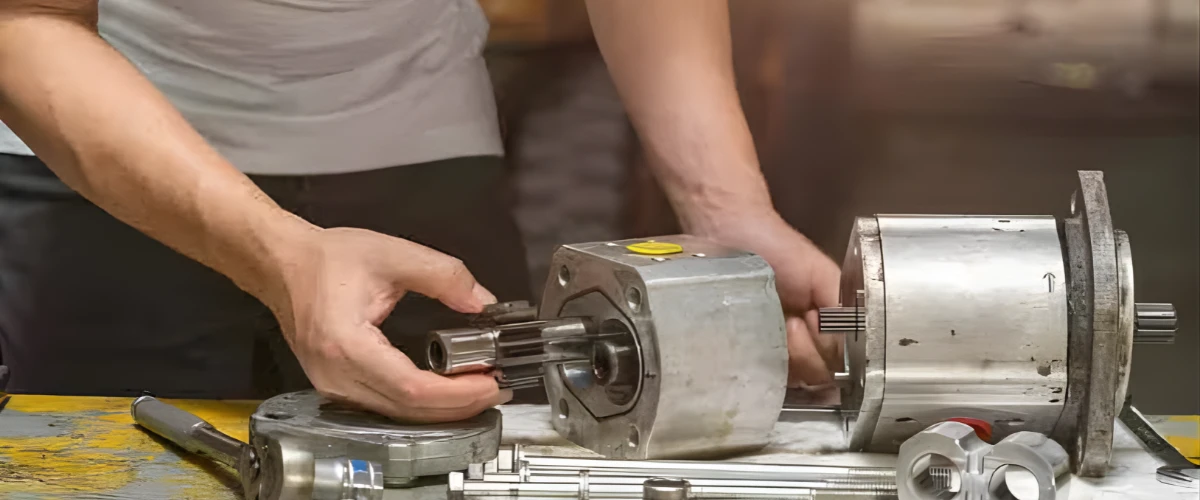
Our technicians carefully disassemble the motor, documenting the condition and arrangement of components. We then clean all parts to remove contaminants and deposits, revealing the true extent of wear and damage.
Step 3: Detailed Component Inspection
Using precision measuring instruments, we evaluate each component against manufacturer specifications:
Shaft and Bearings: Check for wear, pitting, and proper clearance.
Gears or Pistons: Inspect for scoring, chipping, and dimensional accuracy.
Housing and End Covers: Check for cracks, warpage, and wear at critical sealing surfaces.
Seals and Gaskets: Evaluate condition and identify failure patterns.
Step 4: Replacement and Reconditioning
We replace all worn or damaged components with high-quality parts, including bearings, seals, wear plates, and rotating elements. Where economically feasible, we recondition reusable components through machining or surface restoration.
Step 5: Precision Reassembly
Reassembly follows strict procedures, with careful attention to torque specifications, clearances, and alignment. We lubricate all moving parts during assembly to ensure initial protection during startup.
Step 6: Comprehensive Testing
Every repaired motor undergoes functional testing to verify:
Smooth operation across speed ranges
Proper torque development
Case drain leakage within specifications
Noise and vibration levels
Seal integrity under pressure
Why Choose Sidra Hydraulic Service for Motor Repair:
Skilled Workmanship: Our technicians possess deep expertise across all motor types and brands, ensuring repairs are done right the first time.
Comprehensive Service: We handle everything from small gear motors to large piston motors used in heavy construction and industrial equipment. Our comprehensive service range means you have a single trusted partner for all hydraulic repair needs.
Quality Assurance: Every repair undergoes strict quality control and performance verification to ensure reliable results and extended service life.
Fast Turnaround: We understand downtime is expensive. Our efficient processes and advanced diagnostic technology minimize repair time while maintaining quality.
Conclusion:
Hydraulic motor failure doesn't have to mean prolonged downtime and expensive replacement. With professional hydraulic motor repair from Sidra Hydraulic Service, your equipment can be restored to like-new condition at a fraction of replacement cost. Contact us for expert diagnosis and reliable repairs you can count on.